


Tire storage becomes an unexpectedly hard warehouse challenge as the number of tires goes up. Being the main storage issues: tires are bulky, pliable, and handled in masses which means that placing them on the floor maybe is the cheapest and easiest option as a short-time storage, it is not very feasible anymore in situations where a warehouse has also to keep tracks of various tire sizes, production batches, customer orders, and continuous forklift movement. That being the case many tire manufacturers, distributors, automotive parts warehouses, and third-party logistics providers are seeking tire storage racks.
Of the many solutions, stackable tire racks present a rather unique idea. Instead of a permanent pallet racking installation being set against the wall, a stackable rack system means that the rack units can be piled one on top of the other and can be shifted as and when necessary. Additionally, a removable-post rack design could also simplify managing empty racks. But on the contrary, for a warehouse that already has a tire rack system, it may not be a very good idea to just buy standard racks. If the problem is the new rack’s physical matching the existing tire staking interface, then it could be the critical issue.
Why Is Tire Warehouse Storage So Challenging?
Tires have characteristics that make warehouse storage different from conventional palletized products.
First, tires are generally stored in large quantities. A warehouse may receive hundreds or thousands of tires in a short period, and inventory can change quickly depending on production and sales schedules.
Second, tires come in different diameters, widths, and specifications. A storage arrangement that works for one tire size may not be ideal for another.
Third, tires are often moved by forklift or other material-handling equipment. Storage equipment therefore needs to fit the actual warehouse workflow rather than simply provide a place to put the tires.
Finally, floor space is expensive. When tires are stored directly on the ground, the warehouse may lose opportunities to use available vertical space.
These challenges make warehouse managers consider more structured tire storage solutions instead of relying entirely on floor stacking.
What Is a Stackable Tire Rack?
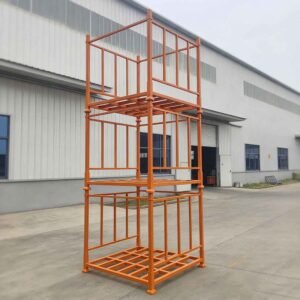
A stackable tire rack is a reusable steel storage frame designed to organize tires and allow compatible rack units to be positioned vertically.
Unlike fixed selective pallet racking, a stackable tire rack does not necessarily require permanent installation of beams and uprights. The rack itself becomes the storage unit.
A typical design may include:
A welded steel base frame
Removable upright posts
Upper and lower stacking interfaces
Positioning components for alignment
A protective surface finish
Features suitable for forklift handling
The main advantage is flexibility. Rack units can be arranged according to current inventory requirements and moved when the warehouse layout changes.
However, stackable does not mean that racks can be stacked to any height. The allowable stacking configuration must be determined by the rack design, load requirements, floor conditions, and site safety procedures.
When Does a Removable Tire Rack Make Sense?
A removable tire rack may offer considerable benefits, especially when the warehouse wants the storage structure to be disassembled and not permanently there.
Supposing there is a warehouse with fluctuating business needs.
In very busy times, many tire racks may be needed.
In less busy times, a great number of racks may be completely empty.
If you don’t take apart those empty racks which you do no longer need, they themselves take up precious floor space in the warehouse.
A rack with removable posts gives still another way around. If the posts are detached when equipment isn’t in use, parts of the rack can be stored separately or the warehouse space can be made more efficient.
This is also very helpful for warehouses that frequently rearrange storage.
For example, a company making tires needs to change storage areas for the finished product at different times during production. Removable racks would be easier and cheaper to change from regular fixed shelves.
How Stackable Tire Racks Improve Warehouse Organization
The value of a tire storage rack is not simply the number of tires it can hold. Good storage equipment should also make inventory easier to manage.
With a defined rack position, warehouses can separate tires by:
Tire size
Product model
Production batch
Customer order
Shipment destination
Storage zone
This can reduce the amount of random floor storage and make inventory areas easier to identify.
Rack identification can also be added to customized equipment. For example, rack numbers or warehouse zone markings can help operators locate specific inventory more quickly.
For large tire warehouses, this type of physical organization can work together with warehouse management systems and barcode or batch tracking processes.
Why Compatibility Matters When Adding New Tire Racks
One of the most overlooked issues in tire rack projects is compatibility with existing equipment.
Suppose a warehouse already has hundreds of stackable tire racks and wants to purchase additional units. The new racks may look almost identical to the old ones, but small differences in dimensions can prevent them from stacking correctly.
Important dimensions may include:
Overall rack length and width
Upright post positions
Post diameter or tube size
Upper positioning components
Lower sleeves
Stacking center
Connection clearances
This is why customized tire storage racks should ideally be developed from existing CAD drawings when compatibility is required.
The external dimensions alone are not enough. The manufacturer needs to understand how the new rack physically connects and positions against the existing rack.
Case Study: 215 Customized Tire Racks for an Overseas Warehouse
A recent JULI project illustrates this type of requirement.
An overseas tire storage customer needed new racks that could work with an existing tire rack system. Instead of supplying a standard model, JULI reviewed the customer’s CAD drawings and checked the key dimensions related to stacking and positioning.
Particular attention was given to the Upper Cup, which used a conical guiding structure designed to match the customer’s existing rack system. The corresponding lower structure and stacking center were also checked during the engineering process.
The final rack used:
Q235 carbon steel
50 × 50 × 3.0 mm square tube upright posts
60 × 60 × 3.0 mm square tube bottom sleeves
50 × 50 × 3.0 mm square tube base frame
Orange powder-coated finish
Removable upright posts
Forklift handling
The external dimensions were 1623 × 1584 × 1714 mm, with internal dimensions of 1503 × 1464 × 1554 mm.
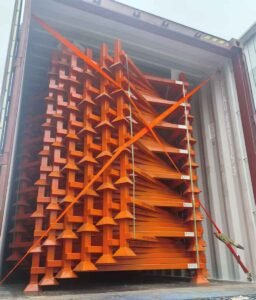
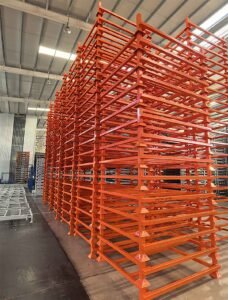
A total of 215 racks were manufactured for the project. The customer also visited the factory to inspect the rack structure and confirm the required identification markings.
The racks were loaded for export from Qingdao in September 2026, with Mexico as the destination.
The project is a good example of why customized tire storage equipment should be evaluated based on actual warehouse interfaces rather than appearance alone.
What Should You Check Before Buying a Tire Storage Rack?
Before choosing a stackable tire rack, warehouse managers should first define the actual storage requirements.
1. Tire Dimensions
Check the diameter, width, and storage orientation of the tires. If several tire sizes will use the same rack, make sure the rack dimensions suit the largest required configuration.
2. Storage Quantity
Determine how many tires need to be stored per rack and how many rack units are required for the warehouse.
3. Handling Method
Confirm whether racks will be moved by forklift and how operators will access the storage area. A storage rack should fit the actual material-handling process.
4. Existing Rack Compatibility
If the warehouse already has stackable racks, provide the existing CAD drawings whenever possible. Check the stacking interfaces rather than comparing only overall dimensions.
5. Required Stacking Configuration
Do not assume that a rack can be stacked to any height simply because it has a stacking interface. The permitted number of levels should be confirmed according to the engineering design, load conditions, and warehouse floor requirements.
6. Surface Treatment
Consider the warehouse environment and required appearance. Powder coating is commonly used for steel storage equipment and can also support equipment identification through color coding.
Custom Tire Storage Starts with the Warehouse, Not the Rack
There is no single tire storage rack that is ideal for every warehouse.
A small tire distributor may prioritize flexibility and easy movement, while a tire manufacturer may need hundreds of identical racks that integrate with an existing production and storage system.
The most reliable approach is to start with the warehouse requirements:
What tires are being stored? How much do they weigh? How many need to be stored? How are they moved? Are there existing racks that the new equipment must match?
Once these questions are answered, the rack structure can be designed around the actual application.
JULI supports customized tire storage rack projects from engineering drawing review through steel fabrication, welding, surface treatment, inspection, and delivery.
If you are expanding an existing tire warehouse or replacing part of an outdated storage system, provide your tire dimensions, existing rack drawings, required quantity, handling method, and storage requirements. These details allow the manufacturer to evaluate the critical dimensions and develop a stackable tire storage solution that fits the way your warehouse actually operates.